
Since the last post about Face Chat, it has picked up three meaningful new abilities. The headline one: it can now plan ahead. Set it a reminder and it will speak to you at the exact time you ask, and it can also schedule itself to repeat tasks, store things in memory, and even run code on a timetable.
Reminders It Will Speak Aloud
Ask it to “remind me at three o’clock that I have to ship the demo” and it will make the call itself. The scheduler keeps the reminder, and when the moment arrives, the head turns its attention to you and speaks it out loud. That is the point: the reminder lands through voice, in the same presence, instead of a notification popping up in another app.
It works for intervals too. “Every morning at nine, tell me the weather” becomes a recurring task. One-shots and recurring schedules both live in the same system, so it can list what it is holding, and you can cancel any of them by name.
It Knows the Time
Scheduling only makes sense if the assistant knows what “today” means. Face Chat now sees the current date and time, so answers about deadlines, meetings, and “when is Saturday?” are grounded in the actual moment instead of guessing. And when you ask it to schedule something like “tomorrow at the same time,” it works that out on its own.
Swap Brains on the Fly
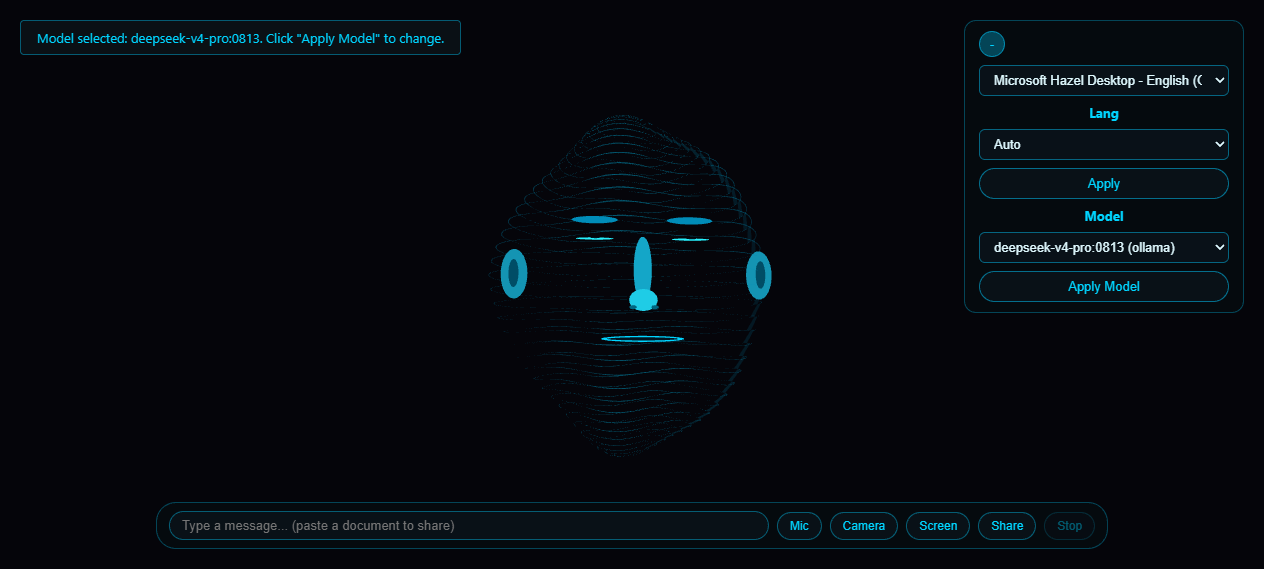
The interface now has a Model picker: cloud models on one side, local models running on your own machine on the other. Pick one, hit Apply, and the next sentence you speak is answered by the new brain, no restart involved. Point it at a local model and the conversation stays on your hardware; pick a cloud model and you get the heaviest reasoning available. The choice is yours, mid-conversation.
Tasks That Do Real Work
A scheduled task is not just a beep. Depending on what you ask for, the one that fires can speak a line, store a note in its long-term memory, run a shell command, or execute a small piece of Python. In practice that means Face Chat can tidy files overnight, fetch a report at 9 a.m., or run a script that checks on something for you while you sleep, and then tell you the result out loud when you wake up.
Steadier Under the Hood
Along the way the connections between the head and the rest of the app got more resilient. If the link drops while it is mid-thought, it recovers quietly instead of freezing, and the memory tools it uses to inspect what it remembers were tightened up in the same pass.
None of this changes what Face Chat feels like to talk to. It still looks back, listens, and answers out loud. It just has more on its plate than the conversation in front of it.